Selfies, Alignment Mosaics, Image Arrays, Image Stacking and Fine Phasing - James Webb Space Telescope's First 9 Images Released To The Public

This “selfie” taken by Webb of its primary mirror was not captured by an externally mounted engineering camera, but with a special lens within its Near Infrared Camera (NIRCam). This special lens is meant for engineering, not science, and allows NIRCam to capture an “inward-looking” image of the primary mirror.

Primary Mirror "selfie" - This “selfie” taken by Webb of its primary mirror was not captured by an externally mounted engineering camera, but with a special lens within its Near Infrared Camera (NIRCam). This special lens is meant for engineering, not science, and allows NIRCam to capture an “inward-looking” image of the primary mirror. This image helps us to check that the telescope is aligned with the science instruments. What you are seeing in this image is the actual primary mirror of Webb as it observes its engineering target, a bright star. All the mirror segments are seeing starlight, but the bright segment is bright because, from NIRCam’s view, the segment is directly aligned with the star. Read more about this image and the other engineering images captured by Webb on our blog. Credit: NASA/STScI

This new “selfie” was created using a specialized pupil imaging lens inside of the NIRCam instrument that was designed to take images of the primary mirror segments instead of images of the sky. This configuration is not used during scientific operations and is used strictly for engineering and alignment purposes. In this image, all of Webb’s 18 primary mirror segments are shown collecting light from the same star in unison.

NIRCam Alignment Selfie - This “selfie” was created using a specialized pupil imaging lens inside of the NIRCam instrument that was designed to take images of the primary mirror segments instead of images of the sky. This configuration is not used during scientific operations and is used strictly for engineering and alignment purposes. In this image, all of Webb’s 18 primary mirror segments are shown collecting light from the same star in unison. Read more... Credit: NASA/STScI

Image mosaic created by pointing the Webb Telescope at a bright, isolated star in the constellation Ursa Major known as HD 84406. Each dot within the mosaic corresponds to a primary mirror segment.
Annotated image mosaic created by pointing the Webb Telescope at a bright, isolated star in the constellation Ursa Major known as HD 84406. Each annotated dot within the mosaic corresponds to a primary mirror segment.

Initial Alignment Mosaic and Annotated Initial Alignment Mosaic - This image mosaic was created by pointing the telescope at a bright, isolated star in the constellation Ursa Major known as HD 84406. This star was chosen specifically because it is easily identifiable and not crowded by other stars of similar brightness, which helps to reduce background confusion. Each dot within the mosaic corresponds to a primary mirror segment. These initial results closely match expectations and simulations. The annotated image identified which mirror segment corresponds to which dot. Read more... Credit: NASA

Webb Telescope Alignment Image Array

Alignment Image Array and Labeled Alignment Image Array - This early Webb Telescope alignment image, with dots of starlight arranged in a pattern similar to the honeycomb shape of the primary mirror, is called an “image array.” Read more... Credit: NASA/STScI/J. DePasquale

Post-Global Alignment Image - This hexagonal image array captured by the NIRCam instrument shows the progress made during the Segment Alignment phase, further aligning Webb’s 18 primary mirror segments and secondary mirror using precise movements commanded from the ground. Read more... Credit: NASA/STScI

Post-Image Stacking image - During this phase of alignment known as Image Stacking, individual segment images are moved so they fall precisely at the center of the field to produce one unified image instead of 18. In this image, all 18 segments are on top of each other. After future alignment steps, the image will be even sharper. Read more... Credit: NASA/STScI

Webb Telescope alignment image of the star 2MASS J17554042+6551277, using a red filter to optimize visual contrast.

Telescope Alignment Evaluation Image - While the purpose of this image was to focus on the bright star at the center for alignment evaluation, Webb's optics and NIRCam are so sensitive that the galaxies and stars seen in the background show up. At this stage of Webb’s mirror alignment, known as “fine phasing,” each of the primary mirror segments have been adjusted to produce one unified image of the same star using only the NIRCam instrument. This image of the star, which is called 2MASS J17554042+6551277, uses a red filter to optimize visual contrast. Read more... Credit: NASA/STScI

Webb Telescope’s Deployment (Infographic)


JWST'S JOURNEY TO L2 -- JWST’s journey from launch to the Sun-Earth L2 point will be filled with a steady stream of spacecraft activities, from unfurling the sunshield (starting 3 days after launch) to unfolding the telescope mirror (13 days after launch). Image: AURA / S. Lifson

How much better is Webb than Hubble? What is the coolest thing Webb is going to be used for? What can we expect to learn about the galactic center of our Milky Way?

The Canadian Space Agency recently had some of its experts working on the James Webb Space Telescope field some questions in a Reddit AMA ("ask me anything").  You can read the whole AMA here.  Below are a few of the highlights.

How much better is Webb than Hubble?

Chris Willott: Webb is better than Hubble in many ways:

- Colder, so better in the infrared.

- Larger aperture, so better sensitivity and spatial resolution.

- Versatile science instruments with a range of observing modes allowing us to take images and spectra in new ways.

Neil Rowlands: Webb's near-infrared instruments (NIRCam, NIRSpec and NIRISS) will be (roughly) 100x more sensitive than any previous instrument / telescope combination. But the mid-infrared instrument MIRI is 10,000x more sensitive than any previous instrument at these wavelengths.

Comparing Webb and Hubble

What is the coolest thing Webb is going to be used for?

Luminita Ilinca Ignat: Personally, I think it would be so cool to see the baby galaxies, a couple hundred million years after the Big Bang. It would be really awesome to see that far in time, and see how our world was born.

GOODS-S/ERS2 Field

René Doyon: Detecting water in the atmosphere of habitable rocky planets. Finding water-worlds, like exoplanets completely covered by an ocean.

NASA’s Webb Will Seek Atmospheres around Potentially Habitable Exoplanets

What potential discoveries excite you the most about the launch and use of the James Webb Space Telescope?

Neil Rowlands: JWST's near-infrared instruments (NIRCam, NIRSpec and NIRISS) will be (roughly) 100x more sensitive than any previous instrument / telescope combination. But the mid-infrared instrument MIRI is 10,000x more sensitive than any previous instrument at these wavelengths. Based on this I would guess that the most surprising discoveries, even completely new phenomena will be from MIRI. I can't wait to see the first MIRI images of the center of our galaxy.

The Infrared Milky Way


What do you expect to learn about the galactic center of our Milky Way?

Chris Willott: The center of our galaxy contains a black hole with a mass of a few million times the mass of our Sun. Surrounding this are many stars and gas clouds whizzing around due to the black hole's gravity. With Webb we will be able to map out the type of stars (old or young) to understand how this region has evolved and also observe the flares of infrared emission that are caused by gas heated when falling towards the black hole.

Hubble-Spitzer colour mosaic of the galactic centre


Is there a primary point of concern for the mission? Be it a stage of the launch or a delicate mechanism that could affect its success?

Neil Rowlands: For most of the deployments, there is some hope that, even if one or two elements fail, there will still be partial capability for valuable astronomical observations. The one single point-of-failure could potentially be the secondary mirror deployment. Without this effective deployment, light from the large primary mirror won't get to the science instruments, so, fingers crossed for that one.

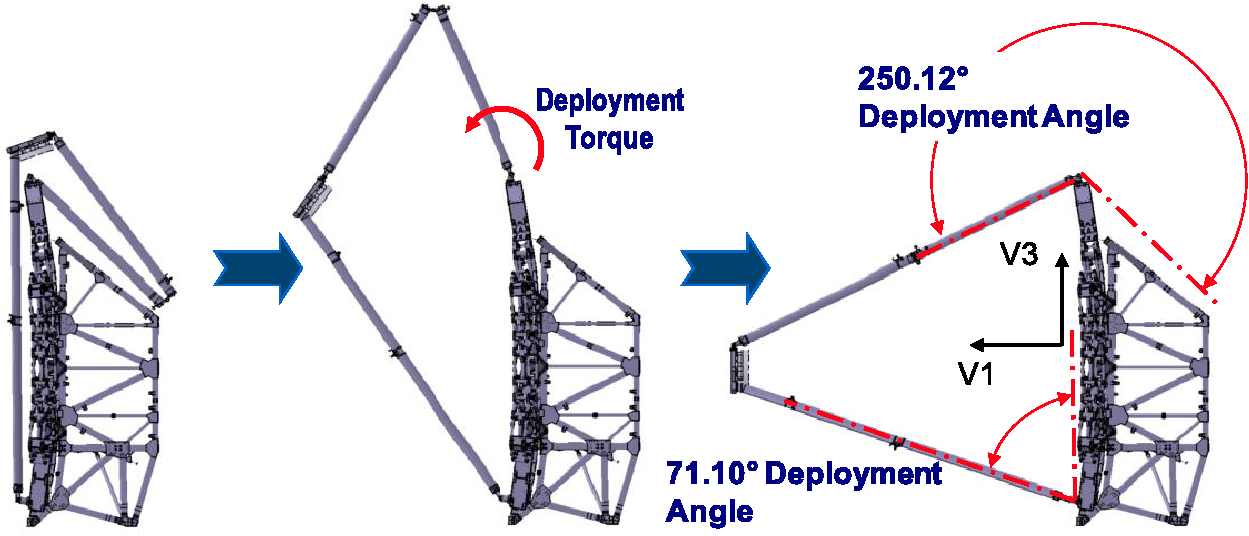
The secondary mirror support structure deployment uses a simple four-bar linkage with a single driven hinge.

Animation Credit: NASA's Goddard Space Flight Center Conceptual Image Lab


Webb Telescope Science Overview

The ESA has published a set of slides in pdf and jpg format detailing Webb's journey to space, instruments and science.  Some examples below.  Complete set of 11 can be downloaded at https://www.esa.int/About_Us/Exhibitions/Webb

The James Webb Space Telescope is the next great space science observatory following Hubble, designed to answer outstanding questions about the Universe and to make breakthrough discoveries in all fields of astronomy. Webb will see farther into our origins: from the formation of stars and planets, to the birth of the first galaxies in the early Universe. Webb is an international partnership between NASA, ESA and CSA. Credit: ESA/ATG medialab

The James Webb Space Telescope will offer a unique view of the outer planets in our Solar System. Looking beyond, Webb will study in detail the atmospheres of a wide diversity of exoplanets. It will search for atmospheres similar to Earth’s in the exciting hope of finding the building blocks of life. Credit: ESA/Hubble, M. Kornmesser

The James Webb Space Telescope can peer through the dusty envelopes around new-born stars. Its superb sensitivity will allow astronomers to directly investigate faint protostellar cores – the earliest stages of star birth. Webb will also see the most massive stars explode as supernovae and leave behind more clouds of dust, gas, and precious heavy elements that enrich the cosmos to form new generations of stars. Credit: ESA/herschel/PACS, SPIRE/N. Schneider, Ph. AndrĂ©, V.Konyves (CEA Saclay, France) for the "Gould Belt survey" Key Programme

Spectroscopy is a tool to better understand the physics of objects in space. Like a prism splits white light from the Sun into its colour components (like a rainbow), the James Webb Space Telescope’s spectrographs will split infrared light into its many wavelengths. This will provide detailed information about an object, such as how a galaxy moves or what molecules are present in an exoplanet’s atmosphere. Credit: ESA/SOT team

The James Webb Space Telescope will observe in near-infrared and mid-infrared, revealing the hidden Universe to our eyes: stars and planetary systems forming in clouds of dust, and the first light from the earliest stars and galaxies ever formed. Credit: ESA/Herschel/NASA/JLP-Caltech, CC BY-SA 3.0 IGO; Acknowledgment: R.Hurt (JPL- Caltech)

The James Webb Space Telescope will explore the early Universe and how galaxies evolved over time. Operating as a powerful time machine that will peer back over 13.5 billion years, Webb will be pushing beyond Hubble’s limits to look back even farther and observe the first stars and galaxies forming. Credit: NASA, ESA and S. Beckwith (STScI) and the HUDF team