I've transitioned to a new home at https://jwstlog.blogspot.com/.
Webb In Focus

Webb Image Sharpness Check Highlights - Engineering images of sharply focused stars in the field of view of each instrument demonstrate that the telescope is fully aligned and in focus. For this test, Webb pointed at part of the Large Magellanic Cloud, a small satellite galaxy of the Milky Way, providing a dense field of hundreds of thousands of stars across all the observatory’s sensors. The sizes and positions of the images shown here depict the relative arrangement of each of Webb’s instruments in the telescope’s focal plane, each pointing at a slightly offset part of the sky relative to one another. Webb’s three imaging instruments are NIRCam (images shown here at a wavelength of 2 microns), NIRISS (image shown here at 1.5 microns), and MIRI (shown at 7.7 microns, a longer wavelength revealing emission from interstellar clouds as well as starlight). NIRSpec is a spectrograph rather than imager but can take images, such as the 1.1 micron image shown here, for calibrations and target acquisition. The dark regions visible in parts of the NIRSpec data are due to structures of its microshutter array, which has several hundred thousand controllable shutters that can be opened or shut to select which light is sent into the spectrograph. Lastly, Webb’s Fine Guidance Sensor tracks guide stars to point the observatory accurately and precisely; its two sensors are not generally used for scientific imaging but can take calibration images such as those shown here. This image data is used not just to assess image sharpness but also to precisely measure and calibrate subtle image distortions and alignments between sensors as part of Webb’s overall instrument calibration process. Read more... Credit: NASA/STScI
How awesome is JWST/MIRI? Well, let's compare the latest press release image to that of the WISE all-sky survey at 4.6 microns. This is the closest wavelength image I could find. Spitzer IRAC would have been better (slightly higher resolution and similar wavelength). pic.twitter.com/EXqP57sULt
— Andras Gaspar 🌻🇺🇦 (@AndrasGaspar) April 29, 2022
Not quite enough distant background galaxies for my taste, but #JWST is looking ever more awesome! pic.twitter.com/pyJ8VH4fUo
— gbrammer (@gbrammer) April 29, 2022
Thank you to @gbrammer for pointing out that the Spitzer SAGE survey took IRAC images of this region! I completely missed this. Check out the evolution of Infrared Space Telescopes! pic.twitter.com/BjrbAgk4ND
— Andras Gaspar 🌻🇺🇦 (@AndrasGaspar) April 29, 2022
Actually here's an even better zoomed view: pic.twitter.com/y49MCm52uy
— Karin Sandstrom (@karinsandstrom) April 29, 2022
Since #JWST's MIRI is getting lots of before-and-after love, I thought I'd do the same for the Fine Guidance Sensor: here's one of its two fields in the Large Magellanic Cloud as previously imaged in the near-IR by @eso's VISTA survey telescope.
— Mark McCaughrean (@markmccaughrean) April 30, 2022
1/ pic.twitter.com/G4yfhPWTqQ
Ok, I’ve never done this, but …here is what this image really says about the first ever deployed, segmented, light-weighted (did I mention cryo?) space telescope, so buckle up… Let’s start with sharp images across 20 arc minutes, that’s almost double the field of view of Hubble thanks to adding an elliptical tertiary that not only expands the field but gives us a reimaged pupil in just right place for a fine steering mirror… (Oh, and that fine steering mirror uses cryogenic difference impedance transducers to sense tilt and voice coils to position and that all had to withstand launch, cooldown…but I digress)… and lets us take these 5-12 minute exposures keeping those stars stable with just tiny mirror adjustments every second without having to body point the 22 meter Sunshield and 8 meter secondary structure (a la Hubble …) And those sharp images are thanks to not only diameter but 18 mirrors polished to under 50 nanometers over 25.4 square meters including compensating for over 100 nm rms per segment of gravity distortion, roughly 150 nanometer cryogenic distortion unique to each segment, and the hardest challenge of all …matching the radius of curvature across all 18 mirrors which required figuring out how to test the mirrors radius of curvature in a cryo chamber (there’s vibration and a refractive window in there folks)… attached to 132 actuators that move coarsely in microns, finely in nanometers all at 30-55 Kelvin attached to rad hard cryo multiplexers and junction boxes and all of that attached to a cryo nanometer-stable custom laminate structure including two deployed wings to a deployed tower with deployed harnesses and cooler lines (who does that?) not to mention vibration attenuators and constrained layer 1 hz isolators at the warm to cold interface so our images don’t jitter and we had to place those mirrors on the backplane with a huge robotic arm, laser trackers, laser radar, and install them strain free within 10’s of microns, shake them to g’s, acoustically blast them to db’s with humongous speakers, then the mother of all tests in a large helium shroud with 4 large windmills with cryo photogrammetry cameras, 3 1.5 meter cryo autocollimating flats, a custom multi wavelength interferometer, novel reflective null lens all to check the primary mirror and cryo alignments so that after launch, then 50 large deployments, then 19 mirror deployments we could finally execute the wavefront algorithms we developed 20 years earlier, demonstrated on a scaled testbed (an engineering marvel unto itself but I digress). All only using the main science camera as the wavefront sensor so we can fit in the rocket without a dedicated wavefront sensor and ... finally, go from 18 blurry dots of a bright isolated star to a phased primary mirror aligned better than 1/5000th of a human hair across 6.5 meters with a secondary mirror 7.2 meters away on a deployed tripod positioned in 6 degrees of freedom to microns all to assure it is not just one central star in focus but stars across the field all perfectly aligned and limited optically by the laws of physics. Nothing elliptical or aberrated or blurry and it all worked. That’s what this picture means… -- lee feinberg


Selfies, Alignment Mosaics, Image Arrays, Image Stacking and Fine Phasing - James Webb Space Telescope's First 9 Images Released To The Public

Primary Mirror "selfie" - This “selfie” taken by Webb of its primary mirror was not captured by an externally mounted engineering camera, but with a special lens within its Near Infrared Camera (NIRCam). This special lens is meant for engineering, not science, and allows NIRCam to capture an “inward-looking” image of the primary mirror. This image helps us to check that the telescope is aligned with the science instruments. What you are seeing in this image is the actual primary mirror of Webb as it observes its engineering target, a bright star. All the mirror segments are seeing starlight, but the bright segment is bright because, from NIRCam’s view, the segment is directly aligned with the star. Read more about this image and the other engineering images captured by Webb on our blog. Credit: NASA/STScI

NIRCam Alignment Selfie - This “selfie” was created using a specialized pupil imaging lens inside of the NIRCam instrument that was designed to take images of the primary mirror segments instead of images of the sky. This configuration is not used during scientific operations and is used strictly for engineering and alignment purposes. In this image, all of Webb’s 18 primary mirror segments are shown collecting light from the same star in unison. Read more... Credit: NASA/STScI


Initial Alignment Mosaic and Annotated Initial Alignment Mosaic - This image mosaic was created by pointing the telescope at a bright, isolated star in the constellation Ursa Major known as HD 84406. This star was chosen specifically because it is easily identifiable and not crowded by other stars of similar brightness, which helps to reduce background confusion. Each dot within the mosaic corresponds to a primary mirror segment. These initial results closely match expectations and simulations. The annotated image identified which mirror segment corresponds to which dot. Read more... Credit: NASA


Alignment Image Array and Labeled Alignment Image Array - This early Webb Telescope alignment image, with dots of starlight arranged in a pattern similar to the honeycomb shape of the primary mirror, is called an “image array.” Read more... Credit: NASA/STScI/J. DePasquale

Post-Global Alignment Image - This hexagonal image array captured by the NIRCam instrument shows the progress made during the Segment Alignment phase, further aligning Webb’s 18 primary mirror segments and secondary mirror using precise movements commanded from the ground. Read more... Credit: NASA/STScI

Post-Image Stacking image - During this phase of alignment known as Image Stacking, individual segment images are moved so they fall precisely at the center of the field to produce one unified image instead of 18. In this image, all 18 segments are on top of each other. After future alignment steps, the image will be even sharper. Read more... Credit: NASA/STScI

Telescope Alignment Evaluation Image - While the purpose of this image was to focus on the bright star at the center for alignment evaluation, Webb's optics and NIRCam are so sensitive that the galaxies and stars seen in the background show up. At this stage of Webb’s mirror alignment, known as “fine phasing,” each of the primary mirror segments have been adjusted to produce one unified image of the same star using only the NIRCam instrument. This image of the star, which is called 2MASS J17554042+6551277, uses a red filter to optimize visual contrast. Read more... Credit: NASA/STScI


Webb Telescope’s Deployment (Infographic)

JWST'S JOURNEY TO L2 -- JWST’s journey from launch to the Sun-Earth L2 point will be filled with a steady stream of spacecraft activities, from unfurling the sunshield (starting 3 days after launch) to unfolding the telescope mirror (13 days after launch). Image: AURA / S. Lifson


How much better is Webb than Hubble? What is the coolest thing Webb is going to be used for? What can we expect to learn about the galactic center of our Milky Way?
The Canadian Space Agency recently had some of its experts working on the James Webb Space Telescope field some questions in a Reddit AMA ("ask me anything"). You can read the whole AMA here. Below are a few of the highlights.
How much better is Webb than Hubble?
Chris Willott: Webb is better than Hubble in many ways:
- Colder, so better in the infrared.
- Larger aperture, so better sensitivity and spatial resolution.
- Versatile science instruments with a range of observing modes allowing us to take images and spectra in new ways.
Neil Rowlands: Webb's near-infrared instruments (NIRCam, NIRSpec and NIRISS) will be (roughly) 100x more sensitive than any previous instrument / telescope combination. But the mid-infrared instrument MIRI is 10,000x more sensitive than any previous instrument at these wavelengths.
 |
| Comparing Webb and Hubble |
What is the coolest thing Webb is going to be used for?
Luminita Ilinca Ignat: Personally, I think it would be so cool to see the baby galaxies, a couple hundred million years after the Big Bang. It would be really awesome to see that far in time, and see how our world was born.
 |
| GOODS-S/ERS2 Field |
René Doyon: Detecting water in the atmosphere of habitable rocky planets. Finding water-worlds, like exoplanets completely covered by an ocean.
 |
| NASA’s Webb Will Seek Atmospheres around Potentially Habitable Exoplanets |
What potential discoveries excite you the most about the launch and use of the James Webb Space Telescope?
Neil Rowlands: JWST's near-infrared instruments (NIRCam, NIRSpec and NIRISS) will be (roughly) 100x more sensitive than any previous instrument / telescope combination. But the mid-infrared instrument MIRI is 10,000x more sensitive than any previous instrument at these wavelengths. Based on this I would guess that the most surprising discoveries, even completely new phenomena will be from MIRI. I can't wait to see the first MIRI images of the center of our galaxy.
 |
| The Infrared Milky Way |
What do you expect to learn about the galactic center of our Milky Way?
Chris Willott: The center of our galaxy contains a black hole with a mass of a few million times the mass of our Sun. Surrounding this are many stars and gas clouds whizzing around due to the black hole's gravity. With Webb we will be able to map out the type of stars (old or young) to understand how this region has evolved and also observe the flares of infrared emission that are caused by gas heated when falling towards the black hole.
 |
| Hubble-Spitzer colour mosaic of the galactic centre |
Is there a primary point of concern for the mission? Be it a stage of the launch or a delicate mechanism that could affect its success?
Neil Rowlands: For most of the deployments, there is some hope that, even if one or two elements fail, there will still be partial capability for valuable astronomical observations. The one single point-of-failure could potentially be the secondary mirror deployment. Without this effective deployment, light from the large primary mirror won't get to the science instruments, so, fingers crossed for that one.
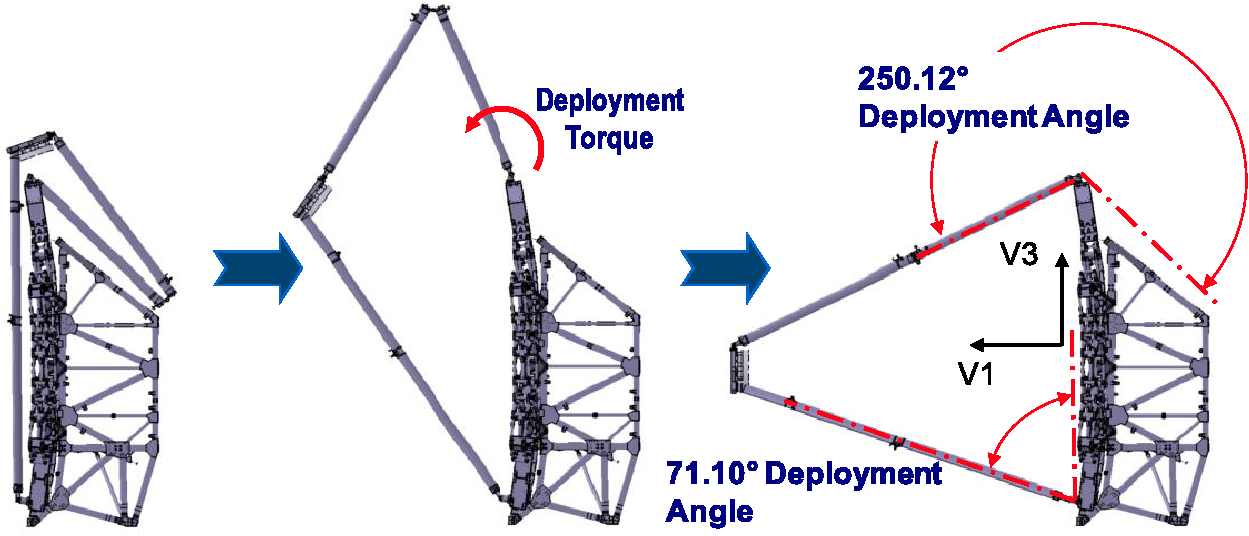 |
| The secondary mirror support structure deployment uses a simple four-bar linkage with a single driven hinge. |
Animation Credit: NASA's Goddard Space Flight Center Conceptual Image Lab
Webb Telescope Science Overview
The ESA has published a set of slides in pdf and jpg format detailing Webb's journey to space, instruments and science. Some examples below. Complete set of 11 can be downloaded at https://www.esa.int/About_Us/Exhibitions/Webb
 |
| The James Webb Space Telescope is the next great space science observatory following Hubble, designed to answer outstanding questions about the Universe and to make breakthrough discoveries in all fields of astronomy. Webb will see farther into our origins: from the formation of stars and planets, to the birth of the first galaxies in the early Universe. Webb is an international partnership between NASA, ESA and CSA. Credit: ESA/ATG medialab |
 |
| The James Webb Space Telescope will offer a unique view of the outer planets in our Solar System. Looking beyond, Webb will study in detail the atmospheres of a wide diversity of exoplanets. It will search for atmospheres similar to Earth’s in the exciting hope of finding the building blocks of life. Credit: ESA/Hubble, M. Kornmesser |
 |
| The James Webb Space Telescope can peer through the dusty envelopes around new-born stars. Its superb sensitivity will allow astronomers to directly investigate faint protostellar cores – the earliest stages of star birth. Webb will also see the most massive stars explode as supernovae and leave behind more clouds of dust, gas, and precious heavy elements that enrich the cosmos to form new generations of stars. Credit: ESA/herschel/PACS, SPIRE/N. Schneider, Ph. André, V.Konyves (CEA Saclay, France) for the "Gould Belt survey" Key Programme |
 |
| Spectroscopy is a tool to better understand the physics of objects in space. Like a prism splits white light from the Sun into its colour components (like a rainbow), the James Webb Space Telescope’s spectrographs will split infrared light into its many wavelengths. This will provide detailed information about an object, such as how a galaxy moves or what molecules are present in an exoplanet’s atmosphere. Credit: ESA/SOT team |
 |
| The James Webb Space Telescope will observe in near-infrared and mid-infrared, revealing the hidden Universe to our eyes: stars and planetary systems forming in clouds of dust, and the first light from the earliest stars and galaxies ever formed. Credit: ESA/Herschel/NASA/JLP-Caltech, CC BY-SA 3.0 IGO; Acknowledgment: R.Hurt (JPL- Caltech) |
 |
| The James Webb Space Telescope will explore the early Universe and how galaxies evolved over time. Operating as a powerful time machine that will peer back over 13.5 billion years, Webb will be pushing beyond Hubble’s limits to look back even farther and observe the first stars and galaxies forming. Credit: NASA, ESA and S. Beckwith (STScI) and the HUDF team |
2012 AMA With Dr. John Mather, Project Scientist For The James Webb Space Telescope
The following are a few questions and answers regarding the JWST from a 2012 Reddit AMA with Dr. John Mather.

Q: 1) What's the next "big step" in terms of space research, after landing curiosity on Mars? 2) What's the best thing about working at/for NASA?
1) Good question! The James Webb Space Telescope is the next big thing in astrophysics, and the Decadal survey produced by the National Academy of Sciences says the next thing after that should be the WFIRST, an wide field infrared survey telescope. Now that the NRO has donated 2 sets of optics to NASA, perhaps one set will become WFIRST. We also have in mind plans for the next great Xray observatory, and a search for gravitational waves using a space interferometer. I think we have at least a century of amazing ideas to carry out.
2) Best thing about working for NASA: thinking about such wonderful possibilities and seeing ideas become reality. Also, I love working with teams of brilliant scientists and engineers every day. Each day is different, and I am so proud of what we are doing together.

Q: How difficult will it be for this telescope to remain at the Lagrangian2 Sun-Earth position? When will it be no longer sustainable to be at the L2 point? I heard it's like trying to balance a marble on a horse saddle. Also, how worried are you about solar radiation at this location, and what steps are being taken to protect the telescope?
The L2 point: it's unstable, but not very. We need to provide rocket force to achieve an acceleration of a few meters per second, per year! So basically the middle of that horse saddle is pretty darned flat. We have to fire the jets every few weeks, just for a short time.
Solar radiation at L2 is about the same as elsewhere, there's nothing special there. But we do have to protect the electronics from solar flares, which produce energetic electrons and protons that pass through and damage the electronics. So we design and test them to survive the dose, and we have some degree of shielding by the structure. We also fly two of everything where it's logically possible.
Q: Given the difficulty of servicing, wouldn't the amount of fuel effectively determine the longevity of the JWST program? If it does leave the L2 point, how much usefulness remains?
Yes, the end of fuel is the end of JWST's useful life. If JWST leaves L2, it's hard to communicate with it even if it can still point at targets.
Q: What do you think is the most exciting thing that the JWST can show to us? what can it help to prove / disprove that we have never had the chance to test before?
I think JWST can produce stunning surprises in many areas. We don't know how galaxies formed or when, we don't know how they got supermassive black holes in their centers, we don't know whether the black holes caused the galaxies to form or vice versa. We can't see inside dust clouds where stars and planets are being born nearby, but JWST will be able to do just that. We don't know how many planetary systems might be hospitable to life, but JWST could tell whether some Earth-like planets have enough water to have oceans. We don't know much about dark matter or dark energy, but we are expecting to learn more about where the dark matter is now, and we hope to learn the history of the acceleration of the universe that we attribute to dark energy. And then, there are the surprises we can't imagine!

Q: Do you judge the JWST will be technologically able to partly "substitute" projects that have been recently cancelled or put on hold? If so, to what extent? Mainly projects in exoplanetary research, like the SIM or TPF, for example.
Thanks! JWST will surely be used for exoplanet research, with direct imaging (with coronagraphs) and with transit spectroscopy. It is not a substitute for SIM or TPF, which are still needed if you want to know a lot about exoplanets. Since only around 1% of exoplanets are transiting their stars, we will be missing most of them with JWST transit spectroscopy. A great help for exoplanets would be to survey the nearest brightest stars for transits, like an all-sky version of Kepler.
Q: Where do you see your field of research in 20 years?
I think we will be swimming in oceans of pictures and data and new discoveries from JWST and other new equipment. Our ground-based telescopes will be about 3x larger than they are today and some of them may have the capability to directly image exoplanets using extreme adaptive optics.
Q: 1) What is more likely to be the limiting factor on JWST's service life: fuel for station-keeping, or liquid gases for cooling? If JWST runs out of coolants first, is an extended "warm mission" possible? 2) Will JWST actually "park" on L2, or orbit around it like WMAP? Where is WMAP now? 3) Once launched, how long will it take for JWST to arrive on-station? Once there, how much time will be required for calibration, etc., before JWST's science can begin?
1) JWST has no liquid gases for cooling. Our early design had solid hydrogen instead, but we've replace that with a closed-cycle refrigerator using helium gas sealed into the equipment. So, fuel for station-keeping is the limiting factor. By the way we also use the fuel for countering the built-up torque due to solar photon pressure on the sunshield.
2) JWST will orbit around L2 like WMAP. WMAP has been sent off into interplanetary space, so it's orbiting the Sun after a very gentle push-off.
3) JWST arrives around L2 in 2 months, which is about the same time it takes to cool down to operating temperature. We are expecting to be in routine science observing mode 6 months after launch.
Q: Will the JWST give us VISIBLE spectrum pictures to view like the hubble?
Yup! JWST coverage begins at 0.6 microns wavelength, which is visible. So some of our pictures may resemble the Hubble pictures, only with different details. Our great hope is to see something completely different from what we can imagine today.


Subscribe to:
Posts (Atom)